
Grounded in ICAR
The questions follow the International Cognitive Ability Resource, an open, peer-reviewed item bank that has been validated against clinical measures in studies with thousands of participants.
Answer 33 reasoning questions and get an instant IQ score, your percentile, and a breakdown across four cognitive domains. The questions are modeled on ICAR, an open research framework — and you never have to hand over an email.
No payment, no paywall on your result. Your answers stay on your device.

Thirty-three questions, four domains, one clear score at the end. No timer, no pressure.
Ready when you are. The test opens on its own page so you can focus — no timer, no sign-up.
Begin the test33 questions · about 10–15 minutes · instant detailed result
A credible cognitive check that doesn't bury your result behind a paywall or a sign-up wall.
The questions follow the International Cognitive Ability Resource, an open, peer-reviewed item bank that has been validated against clinical measures in studies with thousands of participants.
Thirty-three items spread across four domains. Long enough to mean something, short enough that you stay sharp from the first question to the last.
Start the first question right away. There's no email box, no account to create, and no surprise charge waiting at the end.
Scoring happens in your browser. The moment you answer the final question, your IQ score and your four domain results appear on screen.
Each domain captures a different facet of general intelligence, the trait psychologists call g.
Visual matrix puzzles that ask you to find the rule hiding inside a pattern. This is the single best window into fluid intelligence, the raw ability to reason through something you've never seen before.
Vocabulary and word-relationship items that test how well you handle language and draw connections between ideas. This side leans on both stored knowledge and live analytical thinking.
Number sequences and quantitative logic that check whether you can spot structure in figures, run quick mental arithmetic, and apply that thinking to unfamiliar problems.
Mental rotation and visualization tasks that measure how comfortably you turn shapes over in your mind, recognize them after a transformation, and read relationships in space.
Abstract reasoning carries the most weight because matrix puzzles are the cleanest single marker of fluid intelligence. The other three round out the picture so your score reflects a broad profile, not one talent.
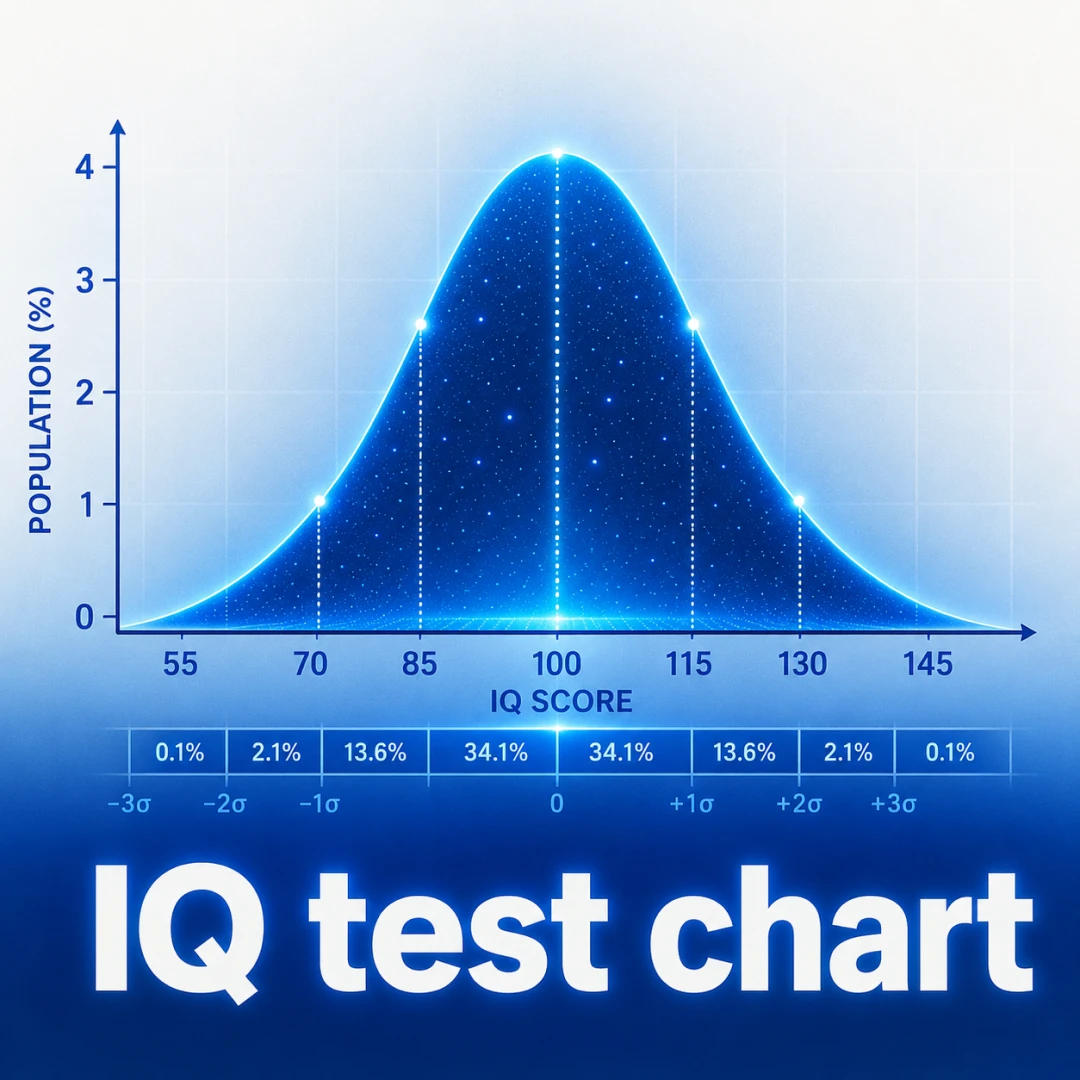
IQ scores ride a bell curve. The peak sits at 100, and most people gather within fifteen points of that center on either side. That fifteen is the standard deviation, and once you know it, the whole scale opens up. About 68 percent of the population lands between 85 and 115. Stretch the window to 70 and 130 and you've captured roughly 95 percent of everyone. Score above 130 or below 70 and you're in the rare two percent at either tail. Your position on this curve tells you how your reasoning stacked up against a large reference group on a particular set of tasks.
One number, though, hides a lot. Two people can post the exact same overall IQ and think in completely different ways. One might glide through the word puzzles while struggling with rotations; the other might be the reverse. That's the whole reason we hand back four separate domain scores. The headline figure tells you roughly where you stand. The breakdown tells you how you got there, and where your real strengths live.
It's worth holding onto what the score leaves out. Curiosity, persistence, the ability to read other people, the discipline to finish hard things — none of that registers on a reasoning test, and all of it shapes a life. Treat your result as one honest data point about how you handle certain puzzles. It is not a verdict on who you are.
Quality on the open web runs the full range, from genuine research instruments to puzzles dressed up as science to harvest your email. The thing that tells them apart is the same thing that separates good science from bad: published methods, peer review, and validity data anyone can check. Our questions come from ICAR, the item bank built by researchers at Northwestern University and tested across study after study with thousands of participants.
How well does that translate to real measurement? ICAR items typically correlate with gold-standard clinical tests like the WAIS-IV in the range of 0.70 to 0.85. For a free, self-administered tool, that is a remarkably strong number. The items reward actual reasoning — spotting a pattern, holding a shape in your head, untangling a relationship — rather than trivia you either happen to know or you don't.
None of that turns an online test into a clinical exam. A professional assessment is run one-to-one, carefully timed, and read by a psychologist who knows your history and watches how you work, not just what you answer. So picture this test as a well-built screen: accurate enough to tell you something real, and honest enough to admit where its limits are.
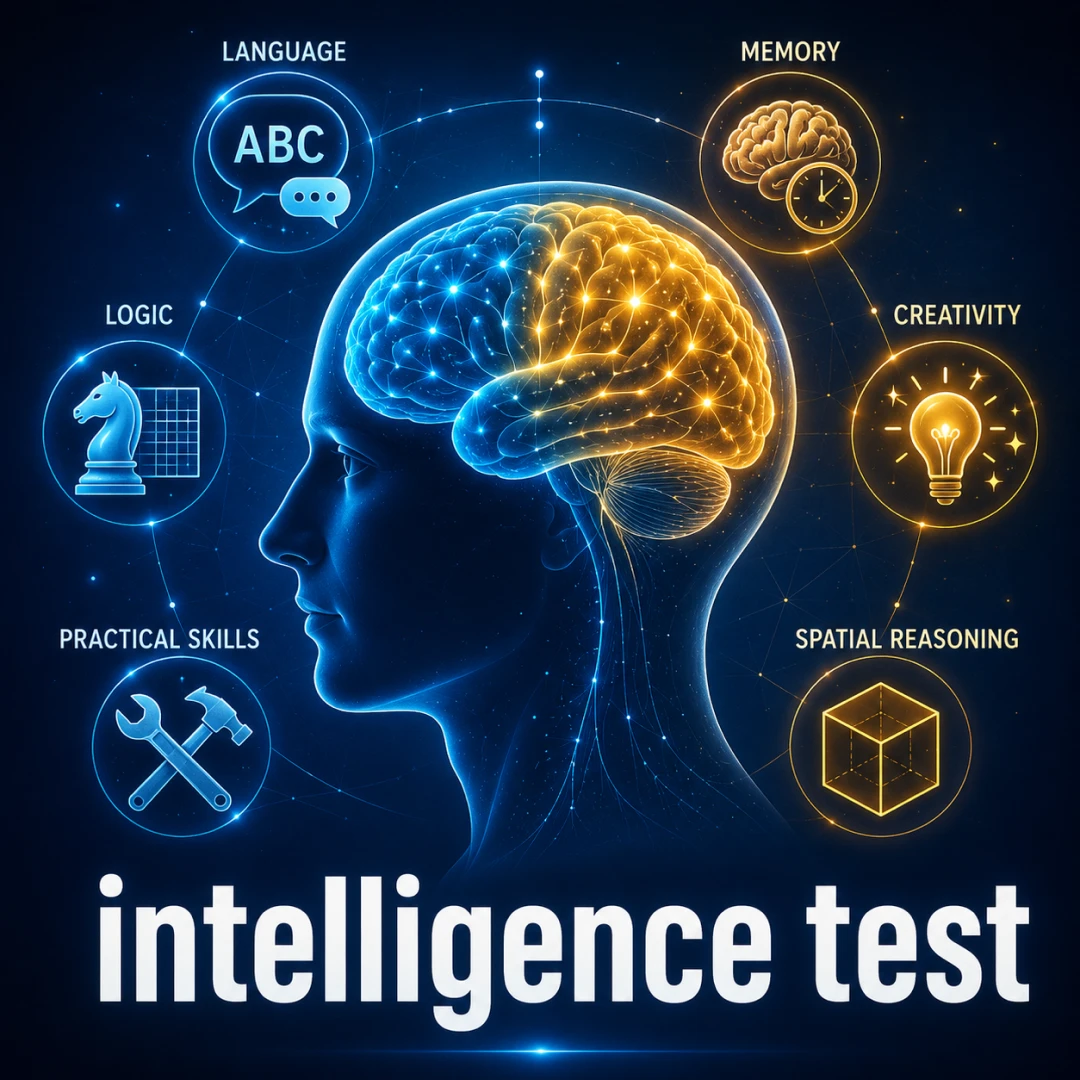
One stubborn finding has shaped the whole field: people who do well on one kind of mental task tend to do well on the others too. Charles Spearman spotted the pattern back in 1904 and named the shared thread g, for general intelligence. More than a century on, g is one of the most replicated results in all of psychology, propped up by enormous datasets and methods Spearman could never have run.
That hardly settles what intelligence is. Howard Gardner argued for at least eight separate intelligences, from linguistic to bodily-kinesthetic. Robert Sternberg proposed a three-part model splitting analytical, creative, and practical ability. The Cattell-Horn-Carroll theory, which most modern tests lean on, tries to bring order to all of it by stacking broad and narrow abilities beneath the umbrella of g.
Pull the threads together and a picture emerges. Intelligence isn't one fixed thing sitting in your skull. It's a family of related abilities that travel together, shaped by genes and circumstances alike, and showing up differently depending on what you're trying to do. g is real and it matters, but it was never the full story of a mind.

Yes, with caveats worth taking seriously. A long run of research links higher IQ to more schooling, stronger job performance, and higher lifetime earnings. People who score well tend, on average, to study longer, earn more, and live longer. The correlation between IQ and job performance sits around 0.50, which by the standards of social science is a heavyweight number.
Averages, though, paper over wild variation between individuals. Plenty of people with middling scores build rich, accomplished lives on grit, social intelligence, and the kind of practical wisdom no test can capture. Plenty of high scorers stall out on bad decisions, work they hate, or quiet unhappiness. The pull of IQ on success is a bit like the pull of height on basketball: it helps, sometimes a great deal, and it's nowhere near the only thing in the room.
Here's a framing that holds up. IQ tends to set the ceiling on how complex a job you can learn to do well. Personality and motivation decide whether you actually go and do it. Both matter, but over the length of a career, character has a habit of outrunning raw horsepower.
Here the research is humbling. Across large studies, the link between IQ and day-to-day well-being is barely there, hovering near zero. Being smarter does not reliably make you happier. If anything, a sharp mind can carry its own freight: more rumination, a keener eye for everything that's wrong, and the odd loneliness of seeing patterns the people around you don't.
So what does move the needle on happiness? The findings point, again and again, to the same handful of things: close relationships, a sense of purpose, decent health, and what gets called emotional intelligence — the ability to manage your own feelings and move through social life without constant friction. None of those tracks tightly with IQ. You can be brilliant and miserable, or perfectly ordinary on a reasoning test and deeply content.
That isn't a knock on cognitive ability. Understanding the world is its own quiet reward, and there's real pleasure in cracking a hard problem or finally grasping a difficult idea. But if you're taking this test hoping a high number will lift how you feel about your life, the truthful answer is that it probably won't. Contentment is assembled out of different materials.
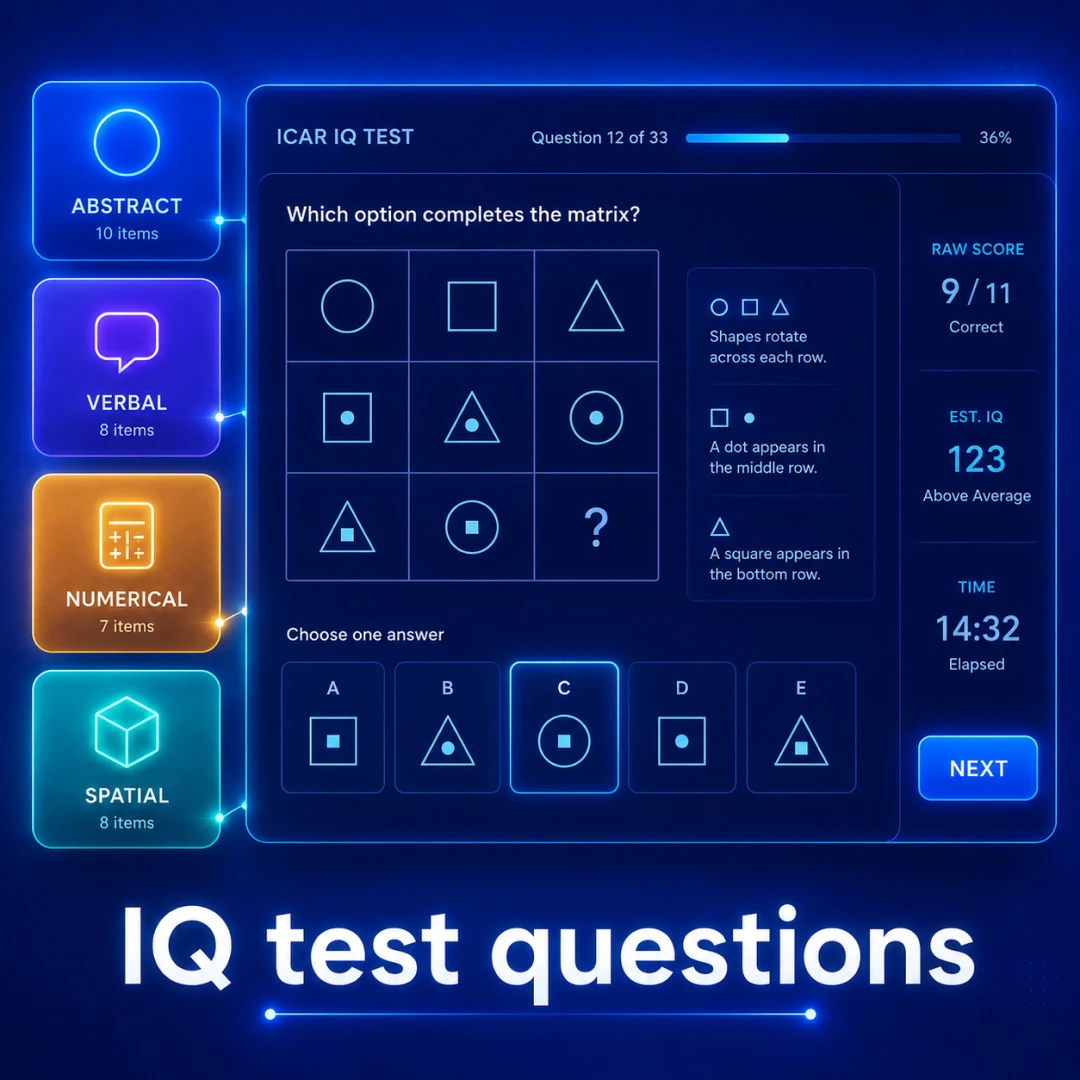
The test runs 33 items drawn from the ICAR framework and spread across four domains: abstract, verbal, numerical, and spatial reasoning. Every item has exactly one correct answer. Your raw score is simply the count you get right, and we convert that count to the IQ scale using normative data from large validation samples. The exact item families and the scoring maths are laid out in full on our methodology page.
The four domains don't carry equal weight. Abstract reasoning, the visual matrix puzzles, takes the largest share of items because matrix problems are the strongest single signal of fluid intelligence — your ability to reason through something genuinely new. Verbal, numerical, and spatial items fill out the rest so the test reads your whole cognitive profile rather than a single narrow band.
All of the scoring runs on your device. Your answers are processed locally, and your IQ score and domain breakdown appear the instant you finish. There's no round trip to a server because there doesn't need to be. You get your result immediately, and your data never leaves your hands. We spell out exactly what we do and don't collect in our privacy policy, down to the short list of values the test keeps in your browser, which the cookie policy names one by one.
The evidence here is kinder than the "intelligence is fixed" cliché suggests. Your genes set a broad range, but where you land inside that range owes a lot to environment and experience. Studies show that staying in school can lift IQ by a few points for each additional year, and that rich early-childhood environments leave gains that last.
Neuroplasticity — the brain's habit of rewiring itself as it forms new connections — means cognitive skills are trainable, within limits. Regular mental challenge, picking up new skills, exercise, real sleep, and decent nutrition all help maintain and modestly sharpen how you think. In adulthood the effects are small rather than spectacular, but they're real and they add up.
What doesn't deliver, despite the marketing, is repetitive brain-training games. The research is fairly blunt: getting better at a specific training task rarely transfers to general intelligence. The things that genuinely seem to help are broader and less gimmicky — reading widely, learning an instrument, working through real mathematics, wrestling with hard problems at your job, and keeping your body active. The brain, like any other organ, responds to how you use it.
How scores are grouped under the standard WAIS-IV system.
| Range | Classification | Percentile | What it means |
|---|---|---|---|
| 130+ | Very Superior | Top 2% | Exceptional reasoning ability. People here tend to excel at abstract problems, complex analysis, and academic work. Many researchers and senior professionals score in this band. |
| 120–129 | Superior | Top 6–9% | Well above the average. Common among people who thrive in intellectually demanding fields and pick up new concepts quickly and with little friction. |
| 110–119 | High Average | Top 16–25% | Above the mean without being unusual. This range is typical of university graduates and people in knowledge-heavy roles. |
| 90–109 | Average | 25th–75th pct | The broad middle of the curve, where about half of everyone falls. A score here reflects solid, ordinary cognitive functioning. |
| 80–89 | Low Average | 9th–25th pct | Below the mean but inside the normal range. Fast or highly abstract tasks may feel harder, though everyday functioning is unaffected. |
| 70–79 | Borderline | 2nd–9th pct | Noticeably below average. Complex reasoning can be a struggle, and a professional evaluation may be worth it if there are functional concerns. |
| Below 70 | Extremely Low | Bottom 2% | May point to an intellectual disability when paired with real limits in daily adaptive skills. A full clinical assessment is essential before any diagnosis. |
These labels describe a statistical position on a curve. They are not measures of worth, potential, or character.
Take every number below with a healthy pinch of salt. Most are popular estimates rather than verified results, and several were never measured at all.
Often described as the finest living mathematician, Tao was solving university-level problems by age nine and won the Fields Medal in 2006.
Once listed by Guinness for the highest recorded IQ, she built a following with her long-running "Ask Marilyn" column.
A prodigy who took gold at the International Physics Olympiad at 13 and was working with NASA on Mars projects by 16.
Retrospective guesses place him somewhere between 180 and 220. His notebooks roam from anatomy to engineering to flight with equal ease.
A childhood Guinness record-holder who was auditing university physics lectures at three and working with NASA as a teenager.
Widely held to be the greatest chess player ever, Kasparov became the youngest undisputed world champion at 22.
He never sat a modern IQ test. The figure of about 160 is a back-calculation from his work on relativity and quantum theory.
Hawking once joked that people who brag about their IQ are losers — even as his own estimated score sat near 160.
Everything worth knowing before you take the test.
An IQ test is a standardized way to estimate how well you reason, spot patterns, and solve problems you haven't seen before. IQ is short for intelligence quotient. Early versions divided a child's mental age by their actual age, which is where the word quotient comes from. Today the math is different: your answers are compared against a large reference sample and placed on a bell curve with an average of 100.
IQ is short for intelligence quotient. The psychologist William Stern coined the term in 1912 to describe the ratio between a person's mental age and their actual age. The quotient label has stuck around even though modern scoring no longer divides one number by another. Your result simply reflects how your performance ranks against everyone else who has taken comparable items.
It's built on ICAR, an open, peer-reviewed item bank that lines up well with clinical tests such as the WAIS-IV. Independent studies have reported reliability and validity that hold up across large samples. It's a strong screening instrument, not a diagnosis. Read your result as a well-informed estimate, and see a licensed psychologist if you need a formal evaluation.
Most people finish the 33 questions in eight to twelve minutes. There's no countdown, so you can sit with a tricky item as long as you like. One practical tip: trust your first read on pattern questions. People who second-guess every answer usually do worse than people who commit and move on.
Your score shows where you land on a bell curve compared with the general population. The midpoint is 100, and roughly two out of three people score between 85 and 115. A result above 130 puts you in the top two percent or so. The number describes performance on a particular set of tasks. It says nothing about your worth, your character, or how far you'll go in life.
Using the WAIS-IV bands: 130 and above is Very Superior and sits in the top two percent. 120 to 129 is Superior. 110 to 119 is High Average. 90 to 109 is the Average band where about half of everyone falls. 80 to 89 is Low Average, 70 to 79 is Borderline, and below 70 is classified as Extremely Low. Each label marks a statistical position, nothing more.
Some of it can. Fluid reasoning, the kind you use on brand-new problems, tends to peak in your twenties and then ease downward. Crystallized knowledge, meaning your vocabulary and accumulated expertise, usually keeps climbing for decades. Schooling, a stimulating environment, and regular hard thinking all leave a measurable mark, so a single score is a snapshot rather than a life sentence.
Yes. You answer the questions, you see your score and your four domain results, and that's the whole transaction. No paywall sits between you and your numbers, and we don't ask for a card. A solid cognitive check shouldn't cost you anything to take.
No. You can start the first question immediately, with no account, no email, and no form to fill in. We deliberately stripped out the onboarding funnel so the test itself is the only thing standing between you and your result.
Each of the 33 questions has one right answer. We count your correct responses, then map that raw total onto the IQ scale using normative data, with the familiar average of 100 and a standard deviation of 15. You also get a separate score for each of the four domains, which is where you find out whether your verbal side or your spatial side is doing the heavy lifting.
Four of them. Abstract reasoning covers visual matrix patterns. Verbal reasoning covers vocabulary and word relationships. Numerical reasoning covers sequences and quantitative logic. Spatial reasoning covers mental rotation and visualizing shapes. Together they sketch a rounded picture of your general cognitive ability rather than one narrow slice.
You can, but a word of caution: once you've seen the items, your second score tends to drift upward simply because the questions feel familiar. Treat your first sitting as the honest one. If you do come back, leave a gap of a few months so the specific puzzles have faded from memory.
The WAIS-IV and the Stanford-Binet are administered one-to-one by a trained psychologist and run for an hour or more. They remain the gold standard for diagnosis. Our test draws on the same family of validated reasoning items and correlates well with those clinical tools, which makes it a dependable screen. It doesn't replace the adaptive questioning or professional interpretation you get in a full assessment.
Not quite. An IQ test captures a specific cluster of abilities, the reasoning and pattern skills that psychologists summarize as g. Real intelligence is wider than any single figure. Creativity, emotional insight, street smarts, and the knack for reading a room all count for a lot, and none of them show up cleanly on a standard IQ test.
It depends on what you're asking. A score of 100 is dead average, and most people land between 85 and 115. Anything above 120 is genuinely strong and puts you in roughly the top ten percent. Honestly, though, the chase for a magic number misses the point. The useful takeaway from a test like this is your profile, not a single threshold to clear.
The average is 100 by design. Test makers periodically re-norm the scale so the population mean stays put at 100 with a standard deviation of 15. In practice that means about half of all people score between 90 and 110, and roughly 95 percent fall between 70 and 130.
It nudges the odds. Decades of research tie higher scores to more schooling, better job performance, and higher pay on average. The link is real but loose. Drive, conscientiousness, social skill, and plain luck often decide the outcome, and in plenty of fields they matter more than raw reasoning. Cognitive ability opens doors; what you do once you're through them is on you.
Both, and the two are tangled. Twin studies put the heritable share of IQ variation somewhere between 50 and 80 percent, with the figure shifting by age and circumstance. Genes don't act in a vacuum, though. The same genetic potential plays out very differently depending on nutrition, schooling, and a stable home. Inheritance sets a range; environment decides where inside that range you land.
It's the steady rise in average IQ scores recorded across most of the twentieth century, on the order of three points per decade. Better nutrition, more years of schooling, and growing comfort with abstract problems are the usual explanations. Curiously, several wealthy countries have seen the trend flatten or even reverse in recent decades, and researchers are still arguing about why.
Parts of it slow down. Fluid reasoning, the speed you bring to unfamiliar problems, softens gradually after your mid-twenties. Crystallized intelligence, your store of words and know-how, often keeps growing into your sixties and beyond. The practical result is that an older mind may be slower on a timed puzzle yet sharper on anything that rewards judgment and experience.
It began in 1905, when Alfred Binet and Théodore Simon built a test to find French schoolchildren who needed extra help. Lewis Terman reworked it into the Stanford-Binet in 1916, and David Wechsler launched his own scales in 1939. The field has matured a great deal since then, and it has also had to confront an ugly chapter in which testing was bent toward eugenics and discrimination.
Take it rested, alert, and somewhere quiet. Don't rush, but don't agonize either; if a question stumps you, make your best guess and keep going. Skip it right after a heavy meal or late at night when your focus is gone. Most of all, come at it with curiosity rather than dread, because anxiety drags scores down.
ICAR stands for the International Cognitive Ability Resource. It's an open, public-domain pool of cognitive items developed by a research group led by William Revelle at Northwestern University. The items are free for scientific and educational use, have been validated across multiple studies, and correlate strongly with commercial tests. In effect, ICAR opened up serious psychometrics to everyone.
Yes. The layout is fully responsive, the tap targets are sized for thumbs, and nothing scrolls sideways on a small screen. A few spatial questions reward a larger display, so a tablet or laptop gives you a slightly easier look at the fine detail, but a phone works perfectly well.
Your answers are scored in your browser and aren't sent to a server. We don't ask for your name or email, and we don't store anything that identifies you unless you choose to share it. The rule we follow is simple: if we don't need a piece of data to run the test, we don't collect it.
IQTests gives you a well-grounded estimate of your cognitive ability, not a medical or psychological diagnosis. If you have concerns about cognition, learning, or development — for yourself or someone you care for — speak with a licensed psychologist or physician who can carry out a full, individual assessment.
Our items and scoring follow published, peer-reviewed work on cognitive measurement.
Thirty-three questions, about ten minutes, and an honest score waiting at the end. No email, no account, no catch.
Take the free IQ test